Selecting repertoire is one of the most consequential decisions a jazz band director makes. Repertoire does far more than determine what will be played at the next concert or festival—it reveals what a director values about jazz, about learning, and about students’ musical lives.
Through repertoire, students encounter style, articulation, phrasing, time feel, form, harmonic language, and history. They also learn—sometimes implicitly—what matters enough to spend weeks rehearsing together. Good programming challenges students musically, sustains their curiosity over time, and invites listeners into the experience without diluting its integrity.
This article is written primarily for directors with limited big band experience, but the considerations that follow apply broadly. Repertoire selection is never neutral; it is an act of curriculum design.
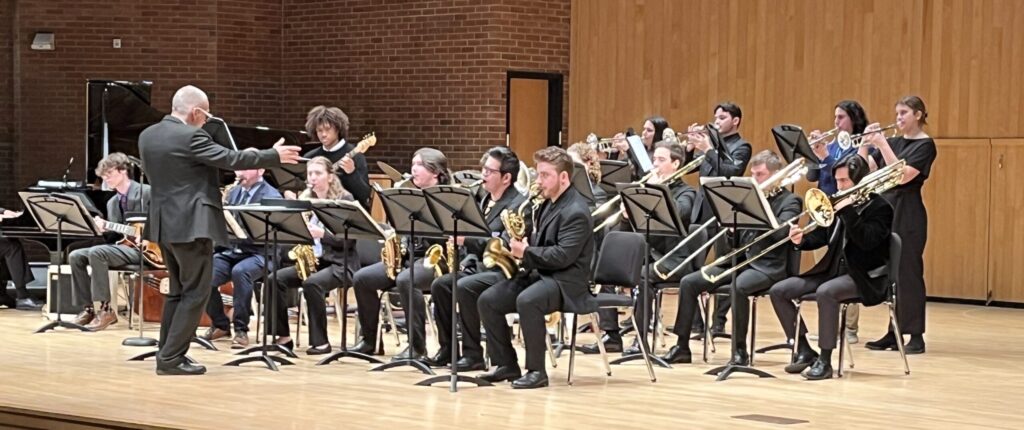
Assess Strengths, Weaknesses, and Growth
Begin with a clear-eyed assessment of your ensemble. Identify the strongest players and sections. Determine which students could be featured meaningfully. Consider realistic brass ranges, endurance, and reading demands. Just as important, identify areas where players are still developing.
Rather than programming solely for the band’s current level, imagine where the ensemble could be by the end of the year with the right challenges and support. Many directors find it effective to introduce more demanding material in the second half of the year, once foundational skills and trust have been established.
Listen—Extensively
Spend time listening before purchasing. Browse publishers’ catalogs and listen carefully to recordings and sound samples, keeping in mind that professional demo recordings often conceal technical challenges.
In addition to large distributors like J.W. Pepper, explore publishers such as eJazzLines, Sierra Music, Pro Jazz Charts, UNC Jazz Press, 3-2 Music Publishing, and Smart Chart Music.
When attending concerts, festivals, and conferences, collect programs. Write down titles, arrangers, and publishers. Over time, this habit builds a personal, trusted repertoire list.
Know Your Arrangers
Certain arrangers consistently produce educationally sound, musically satisfying charts. Writers such as Mark Taylor, Mike Tomaro, and Eric Richards are known for clarity, balance, and playability. Mike Mossman and the late Fred Sturm also belong in this category, though their work generally demands a higher level of technical and musical maturity.
Equally important is introducing students to canonical big band repertoire—music that teaches swing feel, ensemble phrasing, and stylistic nuance through direct engagement with the tradition. Placing Duke Ellington, Count Basie, and Thad Jones alongside Bach or Beethoven as central figures in their respective traditions is not an exaggeration, merely a shift in genre.
The Count Basie orchestra produced an extraordinary body of work. Essential Basie arrangers include:
Sammy Nestico: Basie Straight Ahead, The Queen Bee, Hay Burner, I’m Beginning to See the Light, Smack Dab in the Middle, High Five
Neal Hefti: That Warm Feeling, Li’l Darlin’, Splanky
Frank Foster: Blues in Hoss Flat, Four-Five-Six, Shiny Stockings
Thad Jones’ writing represents another cornerstone of the big band tradition. Historically, much of this repertoire exceeded the technical reach of high school ensembles. Smart Chart Music has addressed this by creating thoughtful, educational adaptations—lowering keys, reducing range demands, simplifying solis, and adding written solos where appropriate—without sacrificing musical integrity. These editions are highly recommended.
David Berger’s transcriptions of Duke Ellington’s music, prepared for the Essentially Ellington competition, are also invaluable. Ellington’s writing presents real challenges: woodwind doubles, extended brass ranges, and orchestrations conceived for flexible instrumentation. These challenges, approached carefully, can be transformative learning experiences.
Programming across eras can help students hear jazz as an evolving art form. Dance band repertoire from the 1930s and 40s (e.g., Jimmy Dorsey, Artie Shaw) pairs well with Basie’s 1950s output, Thad Jones’ work from the 1960s and 70s, and later developments represented by Buddy Rich, Woody Herman, Maynard Ferguson, and Bob Mintzer. While Maria Schneider stands among today’s most significant jazz composers, her work generally requires professional-level technique and doubling expertise.
Ask
Clinicians, adjudicators, guest artists, and experienced educators are invaluable resources. Ask what works, what holds up over time, and what consistently falls flat. Many are also willing—quietly—to steer you away from music that is educationally shallow or stylistically misleading.
Retention and Balance
A useful programming heuristic, attributed to educator Doug Maher, is: “One for the students, one for the audience, and one for yourself.” A Thad Jones chart might satisfy the last category; a groove-based piece might engage students; a familiar standard can help audiences connect.
This approach can be especially helpful when building or sustaining a program. The challenge is avoiding audience pandering. While there may be a place for select pop or crossover charts, they should not replace sustained engagement with strong jazz repertoire. Excellence—musical and artistic—tends to win over students and audiences alike.
Challenge Without Overreach
Most directors wrestle with whether to choose music that sits comfortably within the band’s current abilities or music that stretches them. Students generally respond positively to meaningful challenge, provided range, endurance, and technical demands are respected. Ignoring these realities, however, can undermine confidence and sound.
Modify When Necessary
Once potential selections are identified, evaluate them against your ensemble’s instrumentation. Modest, thoughtful adaptations are often appropriate: reassigning a solo, transposing parts, or redistributing inner voices. Never double lead parts, and always prioritize balance and clarity.
Festival Programming
For a typical three-chart festival set, a balanced approach works well: two canonical selections (e.g., Basie and Thad Jones) paired with a contrasting style such as Latin, straight-eighths, or funk. A ballad can provide expressive contrast and offer a strong soloist an opportunity to shine.
Because festival repertoire is often rehearsed over many months, it may not be ready for early concerts. Programming more accessible material for winter and spring performances—especially pieces that encourage multiple students to improvise—can broaden participation and sustain momentum.
Commissions
Commissioning new work for your ensemble offers rare educational value. Students engage directly with a living composer, and directors play a role in sustaining the art form. Emerging composers—often finalists or winners of competitions such as the Sammy Nestico Award, the Charlie Parker Jazz Composition Prize/Manny Albam Commission, or the Wohlhueter Jazz Composition Contest—are frequently accessible and open to collaboration. Whenever possible, include rehearsal time with the composer.
Standards as a Foundation
At easier difficulty levels, the market is saturated with weak material. Arrangements based on American Songbook standards by composers such as George Gershwin or Cole Porter offer melodic strength and historical grounding. A simple test: if a tune has been recorded by multiple major jazz artists, it is more likely to be worth your ensemble’s time.
Encourage students to listen widely—instrumental and vocal versions alike. Hearing interpretations by artists such as Ella Fitzgerald, Frank Sinatra, or Tony Bennett deepens stylistic understanding.
The abundance of available repertoire makes discernment essential. For every chart worth programming, many more are not. Thoughtful selection—guided by listening, context, and intention—remains one of the most powerful tools a jazz educator possesses.