What books would you suggest local piano teachers use to encourage authentic jazz playing?
This question originally came from a high school music educator working with local piano teachers who wanted to move their students toward more authentic jazz playing. It’s a question I still hear—sometimes verbatim—and it points to a larger issue in jazz education: the assumption that jazz can be taught primarily through method books.
Jazz Piano Books (and What Books Can’t Do)
My short answer then, and now, is this: books are secondary. Jazz is learned first through listening, imitation, and participation. No amount of printed material can substitute for knowing how the music sounds, feels, and breathes.
For younger pianists especially, I would encourage teachers and parents to prioritize exposure over explanation. Surround students with great jazz recordings. Help them internalize swing feel, time, articulation, phrasing, and touch by listening deeply and repeatedly. Discovering the joy of music-making, developing curiosity, and building an emotional connection to the sound of jazz should come before harmonic terminology or voicing systems.
That said, there are books that can be useful once students have begun listening seriously and are ready to connect sound to structure.
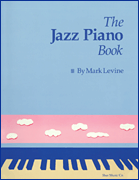 Mark Levine’s The Jazz Piano Book (Sher Music) remains a comprehensive and clearly written reference. While the instructional content is solid, I’ve long felt that the most valuable part of the book is the extensive discography in the back. That listening list alone can guide years of meaningful study and exploration.
For middle school and high school pianists who are beginning to comp in ensembles, Frank Mantooth’s Voicings for Jazz Keyboard is an excellent companion. It introduces functional voicings in a practical, musical way, without overwhelming students with abstraction. Used alongside recordings—and ideally in a group setting—it can help bridge the gap between theory and real-time music-making.
Ultimately, books should serve the music, not replace it. When listening, playing by ear, and ensemble interaction are central, printed materials can become powerful tools rather than crutches. When they come first, however, they often lead students away from the very qualities that make jazz jazz.