Transcribing jazz solos remains one of the most direct and honest ways to learn how this music actually works.
Despite changes in technology, pedagogy, and access to recordings, the fundamental value of transcription has not changed: it trains the ear, sharpens perception, and places students in direct contact with real musical decisions made in real time.
What follows is not a checklist or requirement, but an argument for why transcription continues to matter—especially in an era where
students can access endless information but rarely slow down long enough to listen deeply.
Any student of jazz (myself included) can expect to benefit in the following ways from transcribing recorded solos:
- Demystification
Even within a single masterful solo, patterns emerge: repeated shapes, familiar gestures, favored rhythms.
Students quickly realize that great improvisers are not inventing everything from scratch, but working fluently with a
finite—and deeply internalized—vocabulary. That realization alone can replace intimidation with possibility. - Vocabulary Expansion
Jazz is one of the few musical traditions where borrowing is not only accepted, but expected.
If a phrase captures your attention, it is worth learning—note for note, articulation for articulation—so it can eventually
become part of your own expressive vocabulary. - Nuance Awareness
Transcription forces attention to detail: articulation, dynamics, inflection, tone, time feel, and phrasing.
These elements are rarely captured fully on the page, and cannot be absorbed through theory alone.
- Swing Feel Development
Playing along with recordings—especially at reduced tempo—helps align your internal time feel with the recording.
Matching articulation and note placement at half speed is often more revealing than playing fast. - Improved Reading and Rhythmic Clarity
Learning to notate and organize rhythmic information strengthens the ability to perceive beats clearly and place notes with intention.
This almost always carries over into improved sight reading and ensemble awareness.
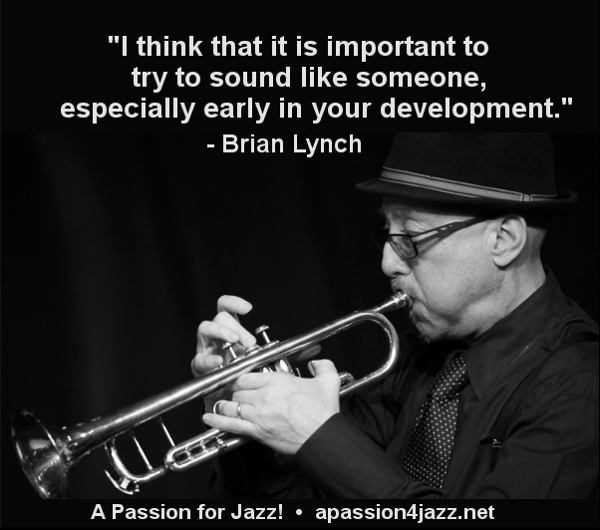
Jazz trumpeter Brian Lynch once said, “I think that it is important to try to sound like someone, especially early in your development.”
That idea aligns closely with Clark Terry’s well-known teaching principle: Imitate. Assimilate. Innovate.
After the Transcription: What to Do Next
Writing a solo down is only the beginning. The deeper work starts after the notation is complete.
Here are several ways to extract lasting value from a transcription:
- Learn it by ear, away from the page
Many great improvisers learned solos without ever writing them down.
Use notation as a tool—not a crutch—and aim for internalization. - Practice at reduced tempo
Use tools like The Amazing Slow Downer
or playback controls on streaming platforms to focus on placement, articulation, and feel. - Gradually return to tempo
Treat the solo like an etude: start slow, then increase speed only when clarity and control remain intact. - Extract and catalog useful ideas
Identify lines that occur over common harmonic situations. Keep a notebook or digital archive. - Transpose with awareness
Practice extracted ideas in multiple keys, always understanding the harmonic function—not just the finger pattern. - Apply ideas in context
Insert learned material into tunes you are already playing, ideally while working with play-alongs or live rhythm sections. - Analyze and vary
Ask what defines the line: rhythm, contour, intervallic content, or harmonic tension.
Write and play your own variations. - Study phrasing and space
Notice how phrases begin and end, how rests are used, and how density changes over the course of a solo.
Understanding why transcription matters—and how to work with it patiently—can transform it from an academic exercise into a lifelong practice. Over time, the goal is not to sound like your heroes, but to sound unmistakably like yourself.