This page preserves a detailed snapshot of how rehearsals, repertoire, practice, and performance preparation were structured for a beginner jazz ensemble.
It is presented not as a template to be replicated, but as a record of thinking-in-practice: how musical priorities were established, how complexity was paced, and how young musicians were guided toward listening, responsibility, and collective awareness.
Dates, personnel, repertoire choices, and logistical details reflect a specific moment in time. What remains relevant is the pedagogical intent beneath them—how rehearsal time was shaped, how material was scaffolded, and how improvisation was introduced without overwhelming the students or flattening the music into abstractions.
Educators are encouraged to read this material selectively. Some will find value in the rehearsal structures, others in the repertoire sequencing, others in the language used to frame practice and performance. The goal is not fidelity to the particulars, but insight into the decision-making process that guided them.
Taken together, the material below functions as a working archive—a laboratory notebook from inside a beginner jazz ensemble—offered in the spirit of transparency rather than prescription.

The ensemble documented here was a small, audition-based middle school jazz combo, formed in 2019 from students who had already demonstrated exceptional aptitude and curiosity through regional jazz programs. After conversations with their band directors, I invited a handful of these students to participate in a twice-monthly ensemble focused specifically on learning how to improvise—slowly, seriously, and in a supportive collective setting.
The group met regularly, rehearsed with intention, and performed in community spaces such as nursing homes, where the emphasis was on listening, ensemble responsibility, and musical generosity rather than competition or display. This page was created as a shared resource for the ensemble: a place where rehearsal plans, practice assignments, repertoire notes, recordings, and reference materials could live together in one coherent space.
Although the ensemble dissolved during the early months of the COVID-19 pandemic, and the students are approaching adulthood, the structure preserved here reflects a model that remains viable. It offers one example of how a middle school or high school director might organize a combo—not as an extracurricular add-on, but as a laboratory for learning how jazz actually works.
Rehearsal Schedule:
- 1st and 3rd Sundays of each month. 1:30 – 3 p.m. @ UConn.
Upcoming Performances:
Date: Sunday, March 1.
Time: 2 PM performance. Arrive between 1:15 and 1:30.
Where: StoneRidge, 186 Jerry Browne Road, Mystic, Connecticut 06355
Set List:
- Satin Doll
- Intro: Rhythm section. 4 measures. Bass & Drums pedal G on 2 & 4.
- Head: 2-feel. 1X for both in & outheads
- Solos: maximum 2 choruses each.
- End: Loop last phrase 3 times, then Basie “plink, plink, plink”, C9
2. Song For My Father
-
- Intro: Bass Line figure by bass and piano, w/ drums (4m’s)
- Head once
- solos: F blues scale
- End: Loop last 2 notes. Slight ritard last time
3. Summertime
-
- Ethan sings
- Mr. MacDonald will bring chord changes in Gmi concert for everyone.
- Intro: last line of the tune, played by everyone
- Solos: use G blues scale
- Ending: tagged ending of last 4 measures, cued by Ethan
4. Cantaloupe Island
-
- Head 2X’s, in and out
- drum solo over Rhythm Section vamp
5. Doxy
-
- slightly faster than the previous tune
- Head twice, in and out
- End: Last line tagged, then Ab7, A7, Bb7
Additional tunes if time permits or if encores are requested:
- Footprints (bass figure intro)
- Maiden Voyage
- Impressions
Personal Practice/Assignments:
Jan. 5, 2020:
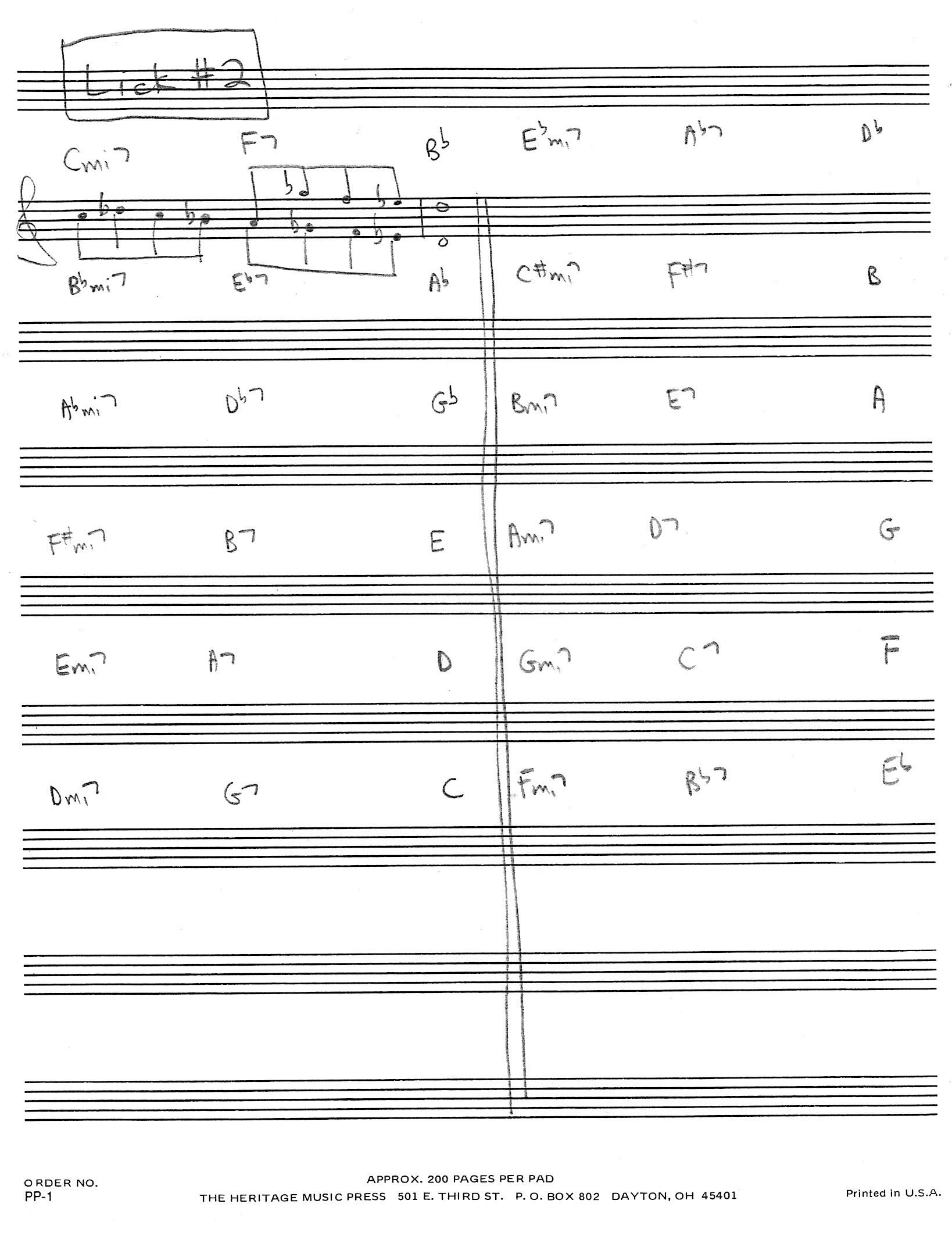
New Lick: Write out the transpositions. Start learning it in 12 keys, doing one transposition at a time. Work your way down the left column first, before learning the keys on the right column.
 New Tunes:
Footprints: https://youtu.be/3XvJFW0DHbU
Maiden Voyage: https://youtu.be/hwmRQ0PBtXU
Also: in addition to the 1,2,3,5 pattern we have been playing around the circle of 4ths, we added a new pattern: 1 3 5 1.
December, 2019:
Here’s a summary of what I’d like us all to practice before our next rehearsal:
- Major scales around the circle of 4ths. (Swing eighth notes. Rest for 2 measures before going to the next key)
- 1,2,3,5 pattern around the circle of 4ths. Quartet notes, for now. Gradually increase the speed once you’ve got it.
- Plug in our “V to I” lick on Autumn Leaves. Practice each lick separately, and isolate the tricky spot where you have 3 in a row. When you are ready, practice with the play-a-long recording. Start by only playing the licks. When this is mastered, feel free to play in the other measures, but never miss a spot where you can insert a lick.
- Try playing Summertime in the new key: G minor. Think about the 3 key areas using Roman numerals.
- Memorize Doxy and Impressions. Be sure to learn the melody for Impressions exactly as it is notated in the Aebersold book. If you learn another version, we will sound sloppy when it is played in unison.
Repertoire:
All selections are currently found within Vol. 54, “Maiden Voyage” (book/CD, book without CD, iTunes) of Jamey Aebersold’s play-a-long series. Bring your book to every rehearsal.

- Sonny Moon For Two (Bb Blues)
- Impressions
- Blue Bossa (Solar Flair)
- Summertime
- Song For My Father
- Doxy
- Satin Doll
- Watermelon Man
At this point, the melodies for most of these pieces should be memorized, or close to it.
Practice Exercises:
- major scales, followed by the 4 triads (maj, mi, dim, aug)
- circle of fourths: 1,2,3,5 pattern
- seventh-chord arpeggiation through tunes (1, 3, 5, 7)
YouTube Videos:
- Sonny Moon for Two (Bb blues)
- Impressions
- Blue Bossa (Solar Flair = play-a-long track)
- Summertime
- Song For My Father
- Doxy
- Satin Doll
- Watermelon Man
Tips (Tune Specific):
- Bb Blues
- Bb and G blues scales both work. Experiment with each.
- Practice singing the root motion. “I — IV — I — I—, IV etc.
- Arpeggiate through the progression. Ascending and Descending.
- Try playing with guide tones only. (3s and 7s, alternating)
- Impressions
- AABA form
- Same harmony as Miles Davis’ “So What.” Listen to this too.
- C major scale for A sections
- Db major scale for B sections
- Try practicing the two major scales in thirds, and then try soloing using thirds.
- Rachael: try to transcribe a 32-bar chorus of the bass line from the play-a-long recording. Let me see what you’re able to accomplish on your own, and then I’ll help if needed. Also all the bass lines from this recording are transcribed in a book which you could order here: http://www.jazzbooks.com/mm5/merchant.mvc?Screen=PROD&Store_Code=JAJAZZ&Product_Code=MVB&Category_Code=
- Blue Bossa (Solar Flair)
- start by “playing around with the melody,” like Kenny Dorham did on the recording
- arpeggiate through the progression (with and without the play-a-long recording). Here’s a handout: https://www.earlmacdonald.com/wp-content/uploads/2019/04/BlueBossa-Arps.pdf
- Summertime
- D blues scale can work for the entire song
- the form is a 16-measure, modified blues
- Ideally, you should try to outline the 3 main key areas: Dmi7, Gmi7 and F major.
- Song For My Father
- F blues scale can get you through the entire tune.
- Be aware of the “break” and have something bluesy and strong ready to plug in here.
- Doxy
- Bb blues scale works throughout.
- Listen to how Miles Davis approaches this solo. Very simple, melodic ideas, using chord tones.
- Satin Doll
- Start by learning the melody really well and then playing around with it.
- Use really simple motifs, sequencing your ideas through the tunes. Start with the roots, then add the second degree of the scale. Go back and forth between the two notes. When this is mastered, add the 3rd degree and then the 5th.
- Watermelon Man
- Again the F blues scale is your friend with this song.
- Like on Song for My Father, be ready for “the break” within the form.
- Don’t get tricked by the song’s extended form. It is 16-measures long; not 12.
Recommended Books and Resources:
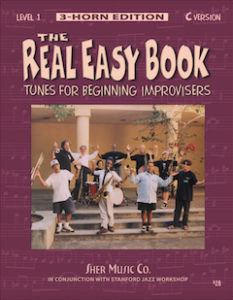
- The Real Easy Book – C, Bb, Eb, and bass clef versions
- Jamey Aebersold Jazz “Play-A-Longs”:
– Vol. 1, “How To Play Jazz and Improvise” (book/CD, book without CD, download tracks)
- Jim Chapin’s “Advanced Techniques for the Modern Drummer” (for Ben only)
- For Rachel: http://www.jazzbooks.com/mm5/merchant.mvc?Screen=PROD&Store_Code=JAJAZZ&Product_Code=MVB&Category_Code=