Two of my UConn jazz students plan to enter the Herbie Hancock Institute International Jazz Vocals Competition. It’s a competition that has launched the careers of outstanding young musicians under the age of thirty, and the featured instrument changes from year to year.
I told them something simple: if they don’t enter, there’s a 100% chance they won’t be selected. If they do enter, they’ll prepare challenging material, grow as musicians, and have their work heard by some remarkable artists. And who knows? There’s a non-zero chance they get selected.
In addition to the standard requirements—a ballad, a medium-tempo Latin/Brazilian selection or jazz standard, an uptempo jazz standard, and a twelve-bar blues—the competition includes a fascinating fifth category:
A performance of an arrangement of a non-jazz work (e.g., rock, hip-hop/rap, R&B/soul, electronic dance music (EDM), sacred music, country, western classical, indigenous music, or an original composition), reinterpreted through a jazz idiom, reflecting the applicant’s individual voice across today’s interconnected musical landscape.
Given jazz’s long history of absorbing, transforming, and hybridizing other musical traditions, this strikes me as a brilliant requirement. It reveals far more than technical ability. It reveals identity.
What music shaped this vocalist? What traditions matter to them? What risks are they willing to take? How imaginative are they? What glimpse of their future artistic voice does this offer?
I encouraged my students to choose carefully. Make it personal. Make it revealing. Avoid the obvious. The judges don’t need another predictable bar-band arrangement of a rock or R&B song with a few jazz chords sprinkled on top. They need to hear you.
Freshman student Isabella Kulawik sent me a video of herself singing Hej Sokoły(pronounced “Hey So-KOH-wih”), a Polish-Ukrainian folk song popular throughout Poland, Ukraine, Slovakia, and other parts of Eastern Europe.
The song tells the story of a young Cossack leaving both his beloved and his homeland behind. It is also known by alternative titles including Żal za Ukrainą (“Longing for Ukraine”) and Na zielonej Ukrainie (“In Green Ukraine”).
She asked a simple question: “Does this have potential?”
My answer was immediate: absolutely.
As I listened, I was struck not only by the beauty of the melody but by how timely the choice felt.
Hej Sokoły is fundamentally a song about love, separation, homesickness, and attachment to one’s homeland. Those themes have always resonated with audiences. Today they carry additional weight.
More than four years after Russia launched its full-scale invasion of Ukraine, millions of Ukrainians remain displaced from their homes. Entire cities and communities have been devastated. Families have been separated. Independent investigations have documented evidence of war crimes, attacks on civilian infrastructure, torture, and the unlawful deportation of Ukrainian children.
These are not abstract geopolitical talking points. They are human tragedies experienced by ordinary people whose lives were shattered because a sovereign nation was invaded.
That reality changes how we hear this song.
A folk song about longing for Ukraine hits differently when Ukrainians are still fighting and dying to preserve their independence. A song about home takes on new meaning when millions have been forced to leave theirs.
At a time when the war risks fading into background noise for many Americans, Hej Sokoły serves as a reminder that the story is not over simply because some people have grown tired of hearing it.
And frankly, that growing indifference concerns me.
What troubles me is not only Russia’s aggression. It is how easily democratic societies become accustomed to aggression when it lasts long enough.
Political leaders move on. News cycles shift. Cameras look elsewhere. Public attention drifts.
Meanwhile, Ukrainians continue paying the price.
I have been deeply disappointed by the willingness of some American political leaders to normalize Russia’s actions, soften their criticism of Vladimir Putin, or treat support for Ukraine as a burden rather than a moral and strategic necessity. I found it embarrassing to watch Ukrainian President Volodymyr Zelenskyy publicly belittled by American leaders while his country continues fighting for its survival.
History has a way of judging these moments.
One of the most effective weapons available to aggressors is the world’s short attention span. When people stop paying attention, outrage fades. When outrage fades, pressure fades. When pressure fades, injustice becomes easier to sustain.
Artists should resist that process.
Art cannot stop a missile. A song cannot liberate occupied territory. But artists can refuse to look away.
We can bear witness.
We can preserve memory.
We can remind audiences that human suffering does not become less important simply because it has become familiar.
That is one reason I find Isabella’s choice so compelling. Whether she intended it or not, she selected a song with personal meaning, historical depth, and contemporary relevance. She chose something that says something.
That is exactly what this competition requirement is designed to encourage.
The melody itself is beautiful and memorable. The harmony, however, is anything but jazz-like.
I put the responsibility on Isabella to create the initial lead sheet. I told her once she did, I would adjust the harmony and create a simple arrangement she could actually use. Here’s the basic lead sheet she gave me:
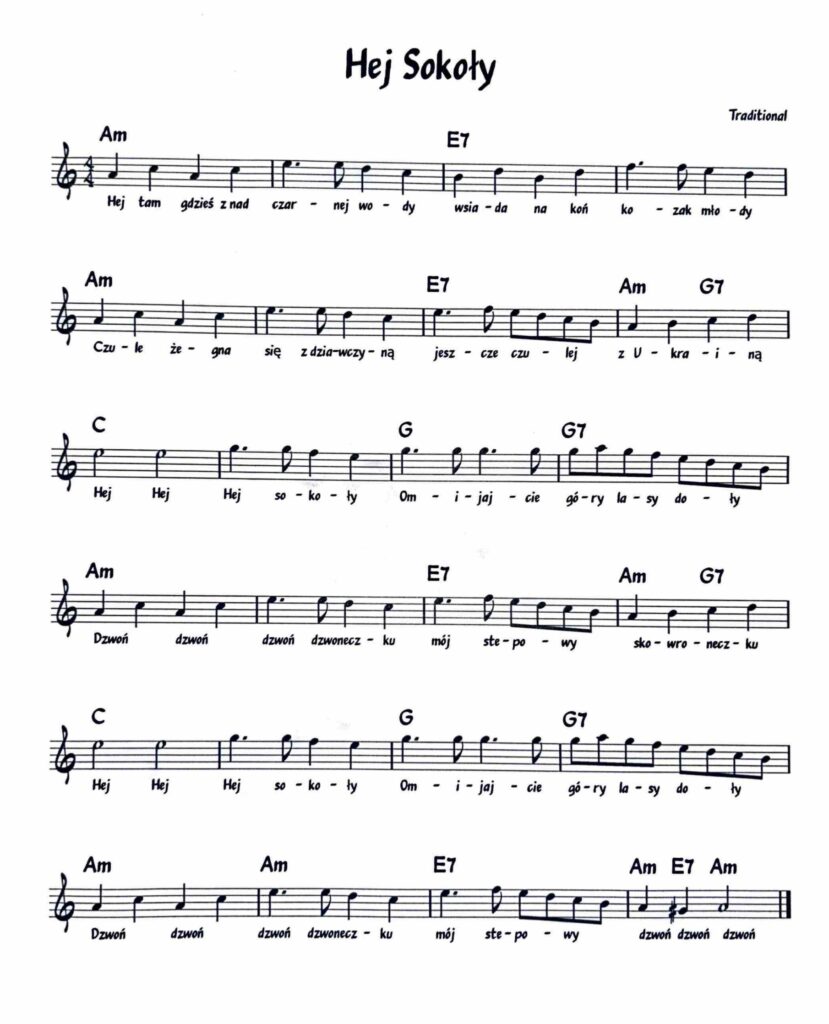
As you can see, the original harmonic language is quite straightforward. Much of the song alternates between tonic minor (A minor) and dominant (E7), eventually moving to the relative major (C major) before returning home.
After spending about an hour with it, I came up with the following reharmonization:
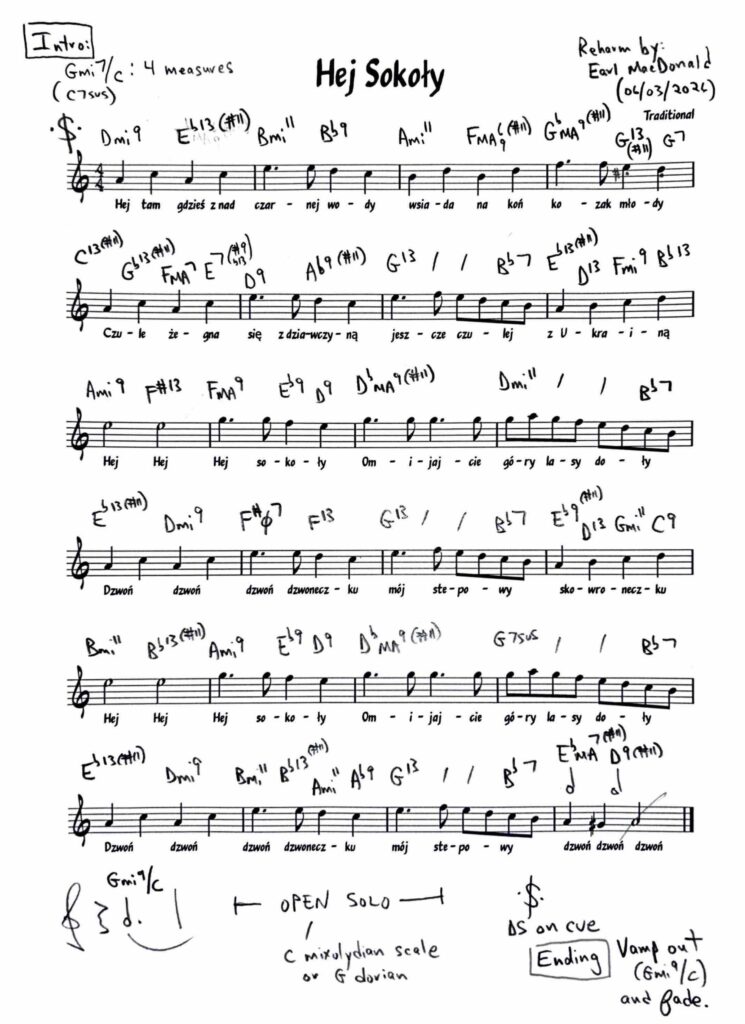 Given the song’s sentimentality, I leaned toward warm sonorities: minor 11 chords, major seventh chords with raised elevenths, suspended harmonies, and occasional dominant chords to create direction and motion.
I wasn’t interested in making it sound aggressively modern or harmonically dense. The goal wasn’t to impress anyone with complexity. The goal was to deepen the emotional palette while preserving the song’s directness and sincerity.
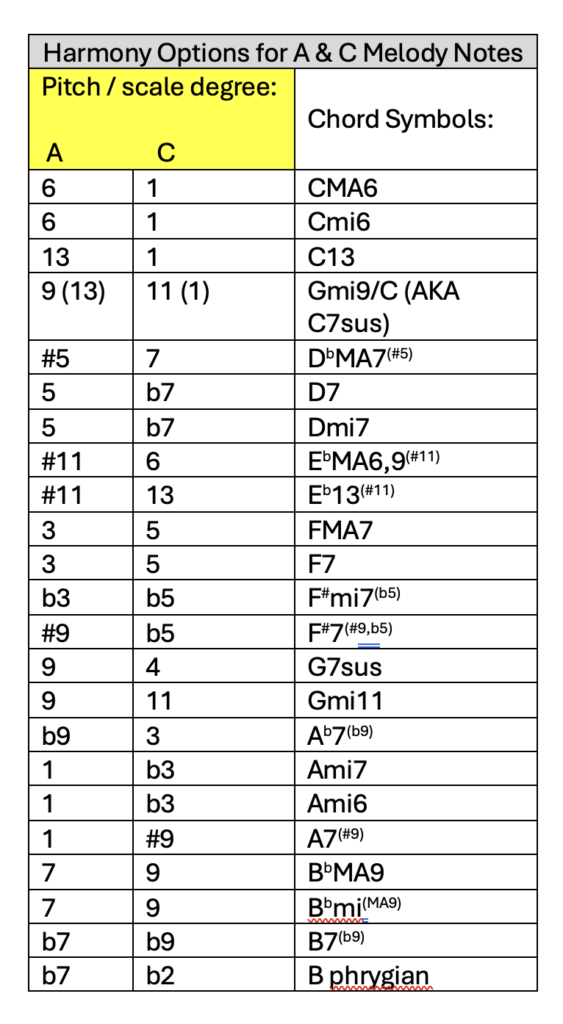
When reharmonizing a melody, one of the first things I do is examine the melody notes themselves and consider the range of harmonic possibilities they suggest.
Take measure one. The melody notes are A, C, A, and C. The original harmony is A minor, which is perfectly logical since those notes represent scale degrees one and flat three.
But those same melody notes can function beautifully over many other harmonic structures. F major. D minor. B-flat major. Various dominant chords. Suspended chords. Altered sonorities.
One exercise is simply listing every harmonic possibility you can imagine and then selecting the ones that best support the emotional character of the piece.
For example:
Another important consideration is harmonic rhythm: how often the chords change.
A reharmonization can change harmony every two measures, every measure, twice per measure, or even every beat. The choice affects pacing, tension, and emotional intensity. Studying fake books quickly reveal how composers manage harmonic rhythm to support melody and form.
Here’s a video of me playing through the reharmonization in my home studio: